
Refractive lens exchange
For adults who want to rely less on glasses, reading glasses too, before a cataract forms. Book a consultation with Dr. Liao directly.

What it is
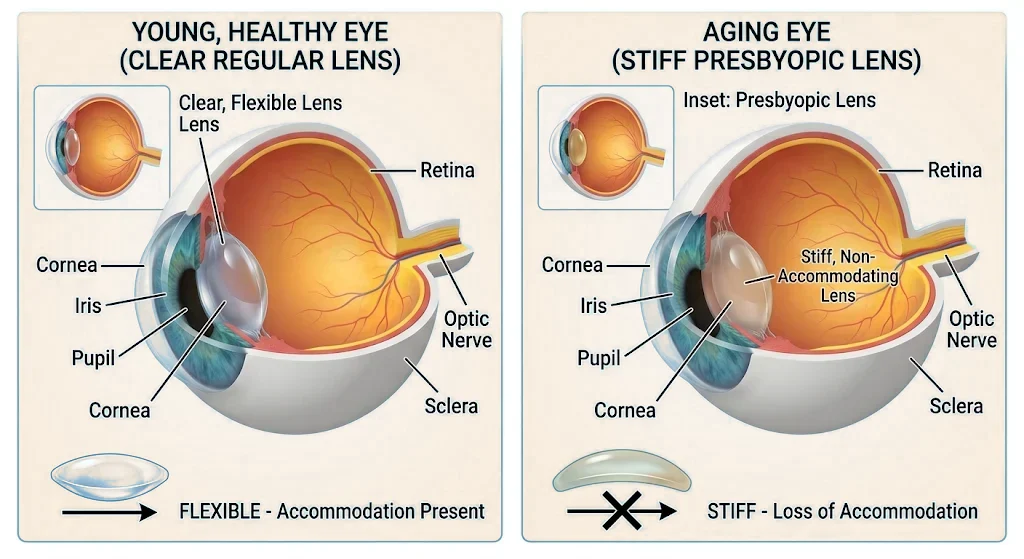
Refractive lens exchange (RLE) replaces the natural lens of your eye with an artificial lens. It is the same procedure as cataract surgery, done before a cataract forms. The goal is to reduce how much you rely on glasses, including reading glasses. Your surgeon removes the natural lens and places an intraocular lens (IOL) inside the eye. Because the natural lens is gone, a cataract cannot form in that eye later. Some people develop clouding behind the new lens over time. This is called posterior capsule clouding. It is usually treated with a quick laser in the office.
Who it is for
- Patients with presbyopia (ages ~40 to 45 and older): more difficulty with near tasks
- Early cataract / dysfunctional lens syndrome (DLS): not yet reached mature cataract criteria but desire refractive correction
- Moderate to high myopes (nearsighted patients) over 40: outside the safe range for LASIK or PRK
- High hyperopes (farsighted patients): poor candidates for corneal based refractive procedures like LASIK or PRK
- Patients seeking a permanent surgical solution: individuals looking to eliminate both their current refractive error and the future development of cataracts in a single procedure
Lens exchange, LASIK or cataract surgery?
| Refractive lens exchange | LASIK | Cataract surgery | |
|---|---|---|---|
| What is changed | The natural lens is replaced with an artificial lens. | The cornea is reshaped with a laser. | The cloudy natural lens is replaced with an artificial lens. |
| Natural lens kept? | No | Yes | No |
| Can a cataract form later? | No. Clouding behind the lens can still happen and is treated with laser. | Yes. The natural lens keeps aging. | No. Clouding behind the lens can still happen and is treated with laser. |
| Typical age | Often mid 40s to 60s | Often 20s to 40s | Most often over 60 |
| Reading glasses after | Depends on the lens chosen. Some people still need them for some tasks. | Usually still needed as presbyopia develops with age. | Depends on the lens chosen. Many people still use them. |
What you give up
- You give up your natural focusing ability. An artificial lens does not change focus the way a young natural lens does.
- Monofocal lenses give clear vision at one distance. You will likely need glasses for other distances.
- Multifocal and extended depth of focus lenses can reduce the need for glasses. Some people notice halos or glare around lights at night.
- Some people choose one eye set for distance and one for near. This does not suit everyone.
- Results vary from person to person. Your surgeon will talk with you about which lens fits your eyes and daily life.
The risks, in plain words
- Infection, inflammation, or elevated intraocular pressure.
- Visual side effects specific to lens choices (e.g., glare, halos, or reduced contrast sensitivity with certain presbyopia correcting IOLs).
- The potential need for secondary procedures.
All surgical procedures carry inherent risks and individual candidacy is determined during a comprehensive consultation.
How to start
- 01
Book a consultation with Dr. Liao. There is a consultation fee.
- 02
Full testing and eye measurements come first.
- 03
Dr. Liao goes over your results and lens options with you.
- 04
If you go ahead, you plan your surgery dates and give consent.
Details coming soon. Call us and we will gladly walk you through it.
Talk it through with Dr. Liao.
Questions about booking or a consultation? See our FAQ